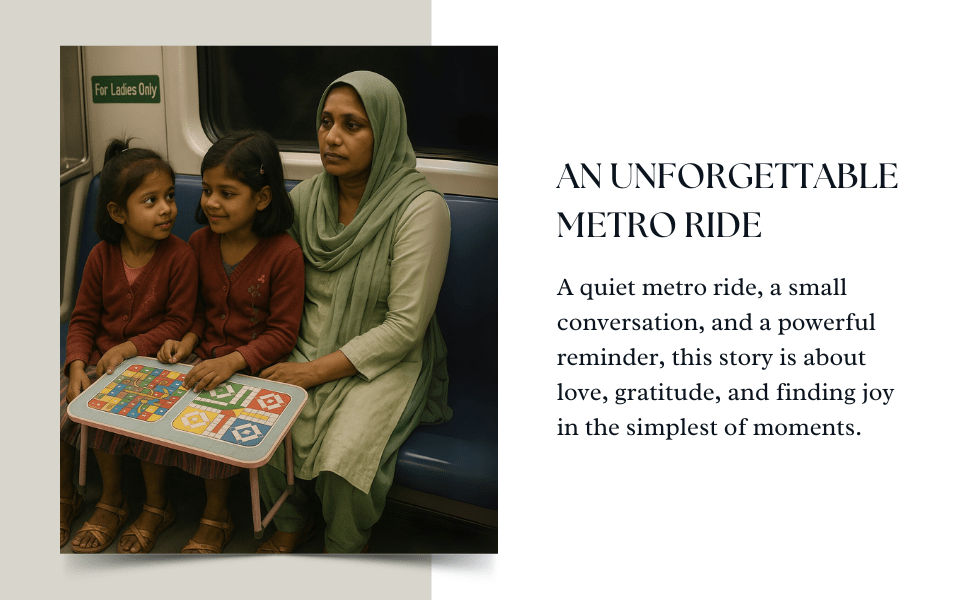
Today, I saw two little girls in the metro with their mother. The girls looked about five and six years old, sitting close together on the corner seat. Both wore matching, slightly dusty sandals and simple clothes. They were carefully holding a small table with a Ludo game printed on it – it looked brand new, as if they had just bought it that day, and they seemed so excited to take it home.
The younger girl had her hair tied up in a half-top fountain ponytail, a playful style that made her look even more innocent and full of life. Next to them sat their mother, dressed in a pastel green salwar suit, her dupatta draped over her head just like in the villages – simple, modest, and dignified. Their clothes looked a bit faded and dusty, hinting at a life where every rupee is stretched and nothing is taken for granted.
They looked like they belonged to a lower-income family – the kind that manages to fill their stomachs but doesn’t have much left beyond that.
I know it might sound judgmental to describe someone based on how they looked; this is how we’ve been wired to understand and differentiate between income classes. (I know that’s something I’m still trying to unlearn and not pass on – but that’s a different story for a different article.)
Coming back to those little girls, the younger one, maybe around 5 years old, looked up at her elder sister, who seemed about 6, and asked, “What do you want for your birthday?” The elder one replied softly, “A geometry box.” Without a second thought, the little one asked, “How much would it cost? 10, 20, 30, 50? I have this much. I’ll buy it for you.”
I’ve never known what it’s like to have siblings – I’m a single child. But in that small, simple moment, I felt like I was witnessing the purest form of love: a little sister ready to spend her entire savings, collected over months, just to make her elder sister smile on her birthday.
When we were kids, a geometry box was the least of our concerns. We saw other kids with fancy, colourful boxes – the ones with extra compartments, shiny scales, and bright colours – and we started comparing: is mine better than theirs? Why is theirs fancier? And here, for someone, a basic plastic geometry box is enough to make her entire birthday special.
It’s not really about a geometry box, is it? If you look deeper, it’s about how we live in a constant state of comparison, and in that race, whatever we have never feels enough. For some, a ₹50 or ₹100 note is just something they might spend on a quick snack or an extra treat without thinking twice. But for someone else, that same note holds dreams, hopes, and small moments of joy that can light up an entire day.
This moment made me pause and reflect. Lately, I’ve started asking myself before buying something: Do I really need this? Do I not already have something similar? And as I started practising this, I realised how much I already have – so much more than enough. Slowly, that constant urge to compare is leaving, and contentment is finding its way in. Life truly becomes easier and lighter when we start appreciating and respecting what we already have.
Watching those two girls today made my heart feel full. It reminded me of how hard my father worked so I could have an easy, comfortable life – a life where I never had to think twice before asking for something as small as a geometry box.
Sometimes, love doesn’t need grand gestures or big words. Sometimes, it’s as simple and pure as a little girl willingly giving up her tiny savings to see her sister happy.
And in that moment, I felt grateful – deeply, quietly grateful.
In the end, it’s moments like these that remind us what really matters. Love, gratitude, and the ability to find joy in small things – that’s what makes life truly rich. And maybe, just maybe, we all need to pause and look around more often to see these quiet lessons unfolding right in front of us.
I haven’t taken metro rides in a while, thinking I earn enough, I can afford cabs, so why bother? But today, for some reason, my heart said, let’s take the metro. Instead of spending ten times the amount on a cab, I chose a ride that cost just a fraction, without compromising on air conditioning or even the chance of finding a seat – or standing if needed.
And now, I feel it was so worth it. Because today, in that small metro compartment, I found a lesson I couldn’t have bought with any amount of money. From now on, I think I’ll choose public transport more often than I ever would have imagined.
PS. It’s not about public transportation. It’s not about geometry boxes. If you truly understand this article, you’ll know what it really means – and what it’s actually about.
With Love
-eika


Beautifully written ,People often take for granted the things they have in abundance
LikeLiked by 1 person